Learning Sciences in Action

Using AI to Support Intentional Professional Learning Design
I have the privilege of collaborating with a district administrator whose work touches nearly every layer of secondary teaching and learning, from curriculum leadership and campus administrator support to long-term instructional planning and systems coherence. Our conversations often center on how professional learning can move beyond isolated events and become part of a larger vision for instructional improvement.
Several months ago, she discovered the book Powerful Teaching and immediately recognized that a deeper understanding of the science of learning needed to become a focus for the upcoming school year and beyond. She also understands the importance of modeling meaningful uses of technology, including artificial intelligence, as part of that learning journey.
I’ve been studying the learning sciences for nearly a decade (see this earlier post about designing professional learning that sticks), and I’m equally curious about how AI tools can support the design of learning experiences (something I explored in this post about extending professional learning with AI). Her vision for this work aligned naturally with many of my own interests and areas of practice.
(And how fortuitous that the previous two issues of The Learning Professional focused on Applying the Science of Learning and Learning with AI!)
This post shares a few of the ways we are combining those ideas as we design learning experiences intended to equip district leaders and campus administrators with shared language, instructional moves, and practical applications connected to the learning sciences.
Planting Seeds Before a Session
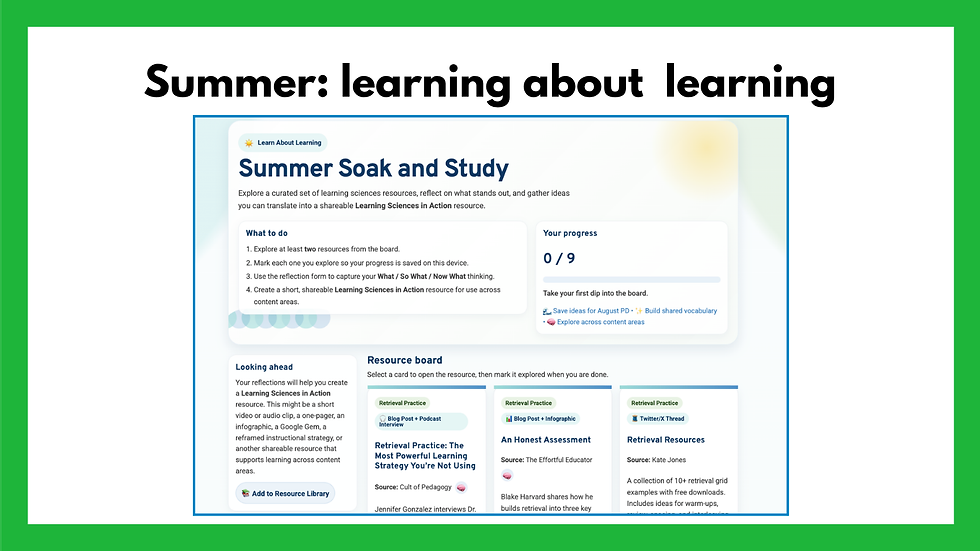
To begin the new school year with a focus on the learning sciences and further cultivate a culture of learning, the district leader and I developed a summer learning experience for her curriculum team.
Together, we curated articles, podcasts, newsletters, social media threads, and infographics connected to different aspects of the learning sciences. AI tools helped transform those resources into an interactive “Summer Soak and Study” choice board. Curriculum leaders will select two or more resources, submit reflections, and create an artifact to synthesize and share their learning with others.
As a result, the team will walk into their August meeting already equipped with shared language, ideas, and experiences connected to the learning sciences. Throughout the year, the district leader plans to continue highlighting participants’ contributions and building on what they learned during the summer experience. Team members will also be encouraged to extend the conversation by sharing additional resources and insights throughout the year.
We are also designing a similar experience for summer sessions with campus principals. Before leaders ever walk into the session, they will have already started learning.
To introduce key concepts from the learning sciences, I used AI tools to create an interactive drag-and-drop vocabulary experience for campus leaders. Participants will receive the game several days before the session and will be encouraged to spend a few minutes exploring the concepts before arriving.
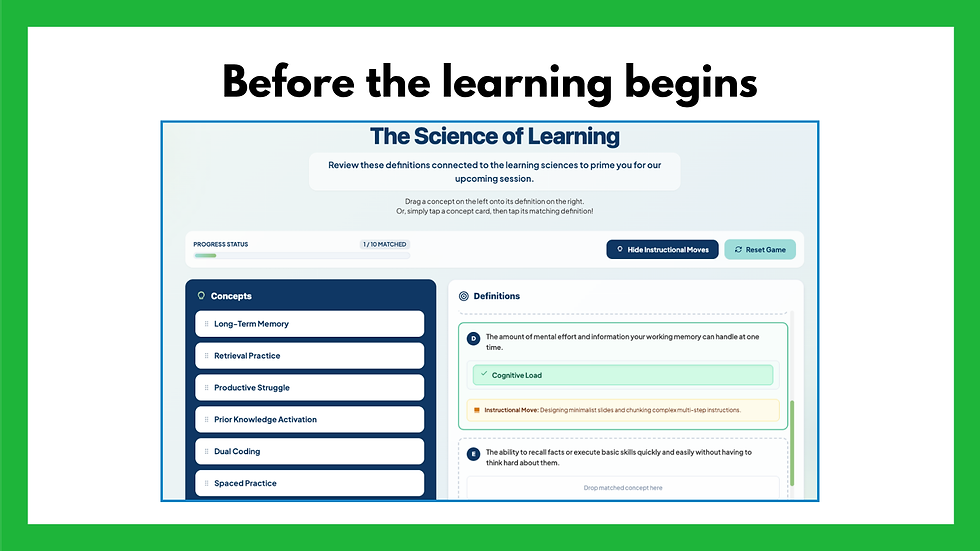
Participants match vocabulary terms such as retrieval practice, prior knowledge, and cognitive load with brief definitions. Hints within the game reference instructional moves connected to each concept, and an additional Gemini-enhanced section generates classroom look-fors, misconceptions, and PLC or coaching prompts.
The goal is not simply to “gamify” the learning. The activity itself was intentionally designed around principles from the learning sciences: activating prior knowledge, creating productive struggle, and strengthening retrieval through repeated exposure to key ideas.
The drag-and-drop activity will also be shared with the curriculum team. While many participants may already have some familiarity with the concepts from their summer learning experience, revisiting the vocabulary through retrieval and feedback can strengthen understanding over time. More importantly, both district curriculum leaders and campus administrators will be building a shared language and collective understanding of the learning sciences together.
Learning Sciences in Action
During the presentations themselves, the district leader plans to explicitly name the learning science principles embedded within the session design. Because she will consistently facilitate learning with both curriculum leaders and campus administrators throughout the year, our hope is that participants will eventually begin recognizing and naming those moves themselves and ultimately embedding them into their own instructional and leadership practices.
For example, one recurring focus throughout the sessions is cognitive load. In Design for How People Learn, Julie Dirksen describes one of the central responsibilities of a learning designer as “the ruthless management of cognitive load.”
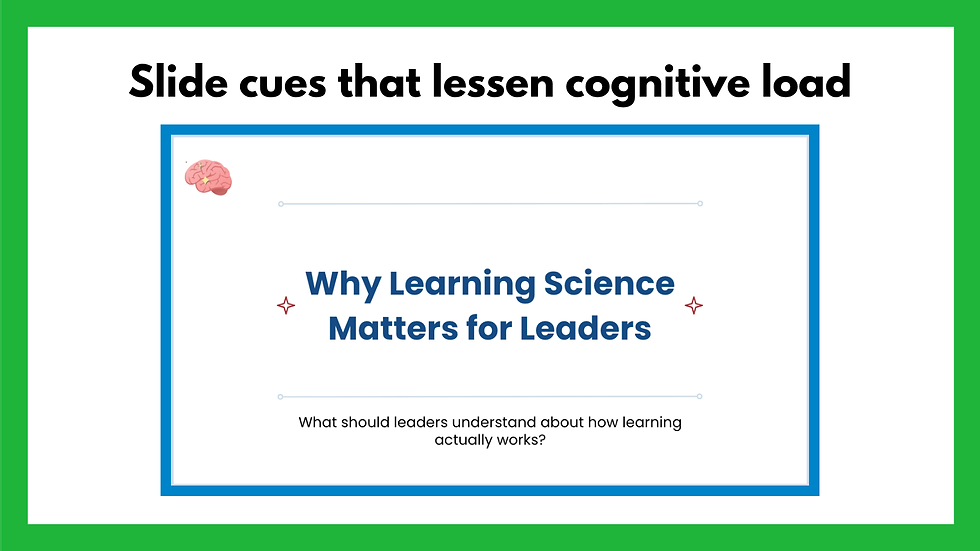
That principle has influenced several small but intentional design decisions. The district leader uses one consistent Slide theme for her curriculum team and another for campus administrators, each aligned to district colors and visual expectations. Over time, those familiar visuals reduce unnecessary processing for participants and create consistency across meetings, resources, and learning experiences.
We are also using a small “brain and sparkles” icon throughout the presentations as a visual cue for “learning sciences in action.” Whenever the icon appears, it signals a moment where the facilitator is intentionally modeling or naming a learning science principle during the session.
Additional session structures are designed with these same principles in mind: retrieval opportunities used as warm-up prompts, intentional pauses for reflection, chunking content into manageable sections, and creating small moments of productive struggle during collaborative tasks.
Rather than simply talking about the learning sciences, the district leader is intentionally helping participants experience those principles throughout the learning process itself.
Extending the Learning Through Curation
Another way we are using AI to support this work is through curated NotebookLM spaces for both curriculum leaders and campus administrators.
Rather than asking leaders to independently search for articles, podcasts, and instructional resources related to the learning sciences, I curated high-quality materials and organized them into a single place. Participants can then interact with those resources through a familiar chatbot-style interface while focusing more of their attention on applying ideas instead of locating information.
During the principal sessions, leaders will use a Learning Sciences NotebookLM space as part of a collaborative deep dive into one of the concepts. Teams will explore applications for their own campuses and discuss what these ideas might look like in practice. The NotebookLM space provides a shared starting point while also reducing the time spent sorting and filtering resources.
In many ways, this is also a strategy for managing cognitive load. By reducing the cognitive burden of searching for information, we can help participants spend more of their mental energy making connections, reflecting on implications for their own roles, and identifying practical next steps.
Because the resource remains available after the sessions, leaders can continue revisiting concepts, exploring examples, and extending their learning over time. Our NotebookLM becomes less of a search tool and more of a curated thinking environment for ongoing professional learning.
The goal is not to use AI simply because it is new or innovative. The goal is to design coherent, evidence-informed professional learning experiences that align with how adults learn best.
As we plan these learning experiences, I keep returning to one central idea: the learning sciences should not simply become another collection of strategies to study. They should shape how we design learning experiences in the first place.
Many of these principles have already been embedded throughout our professional learning design work for years. What feels different in this particular focus is the intentional naming of those moves and the creation of shared language across curriculum leaders and campus administrators around practices already embedded throughout our work.
The learning sciences became not only the content of the learning, but also a lens for the design of the learning experience itself. AI simply helped us create intentional touchpoints for that learning before, during, and after the session.
Kathryn Laster brings over 30 years of education expertise as a math teacher, instructional coach, and digital learning consultant. As an independent consultant, she creates and facilitates transformative learning experiences through intentional, human-centered, tech-infused design, with a goal of normalizing excellence in professional learning.
Connect with Kathryn at kathrynlaster.info and at Refined Learning Design.